
STP Plant Manufacturer & Supplier – Advanced Sewage Treatment Plant Solutions
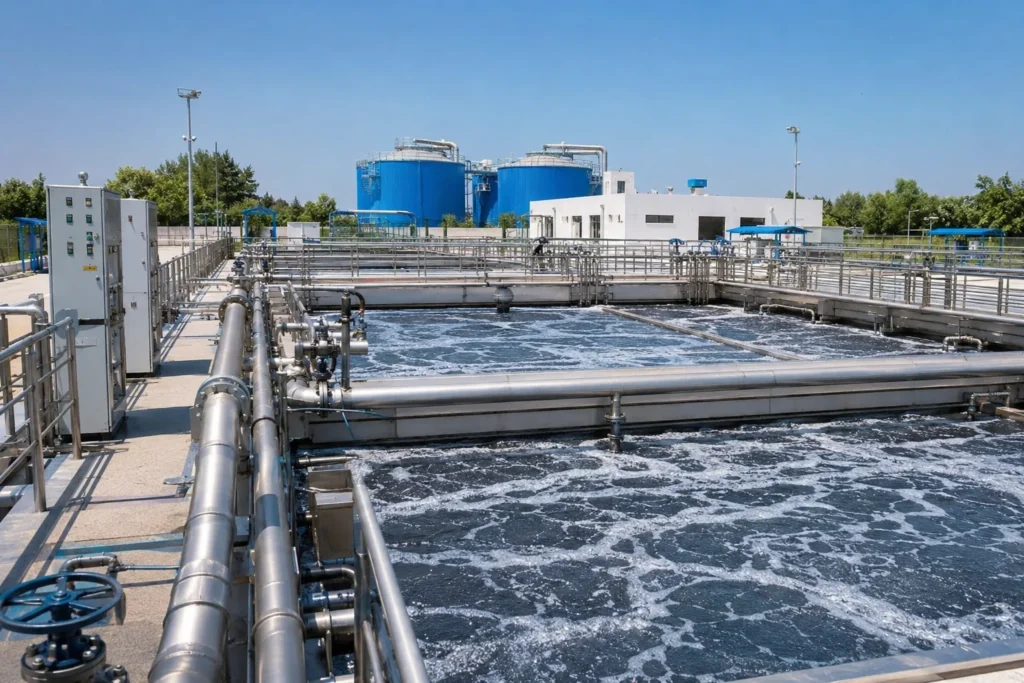
An STP Plant plays a vital role in modern wastewater management. Growing residential, commercial, and industrial developments generate large amounts of sewage every day. Untreated sewage can contaminate water bodies, harm the environment, and create serious health risks. A properly designed STP Plant helps treat wastewater efficiently and makes it suitable for reuse or safe discharge.
Apiance Technology is a trusted name in water and wastewater treatment solutions. We provide advanced STP Plant systems for residential societies, commercial buildings, hospitals, hotels, educational institutions, and industrial facilities. Our solutions are designed to meet pollution control standards while reducing water consumption and operational costs.
With years of industry experience, Apiance Technology delivers customized wastewater treatment solutions backed by expert engineering support, quality equipment, and professional installation services. Learn more about our company and our commitment to sustainable water management.
Get a Customized STP Plant Proposal
Share your project requirements and receive a tailored STP Plant solution with the right technology, capacity, and treatment process.
What is an STP Plant?
An STP Plant, also known as a Sewage Treatment Plant, is a wastewater treatment system designed to remove contaminants, suspended solids, organic matter, and harmful microorganisms from sewage water.
The primary objective of an STP Plant is to convert wastewater into treated water that can be reused for gardening, flushing, cooling towers, landscaping, and other non-potable applications.
A modern STP Plant uses physical, biological, and chemical treatment processes to achieve the desired water quality standards. The treated water helps reduce freshwater consumption and supports sustainable water conservation practices.
Why is an STP Plant Important?
Water scarcity is becoming a major challenge across cities and industrial regions. An STP Plant helps organizations reduce their dependence on fresh water sources by recycling wastewater.
- Reduces environmental pollution
- Supports water conservation
- Ensures regulatory compliance
- Reduces sewage disposal costs
- Improves public health and hygiene
- Supports sustainable development goals
- Enables wastewater reuse
Installing an STP Plant is no longer just an environmental responsibility. It has become an operational necessity for residential, commercial, and industrial projects.
How Does an STP Plant Work?
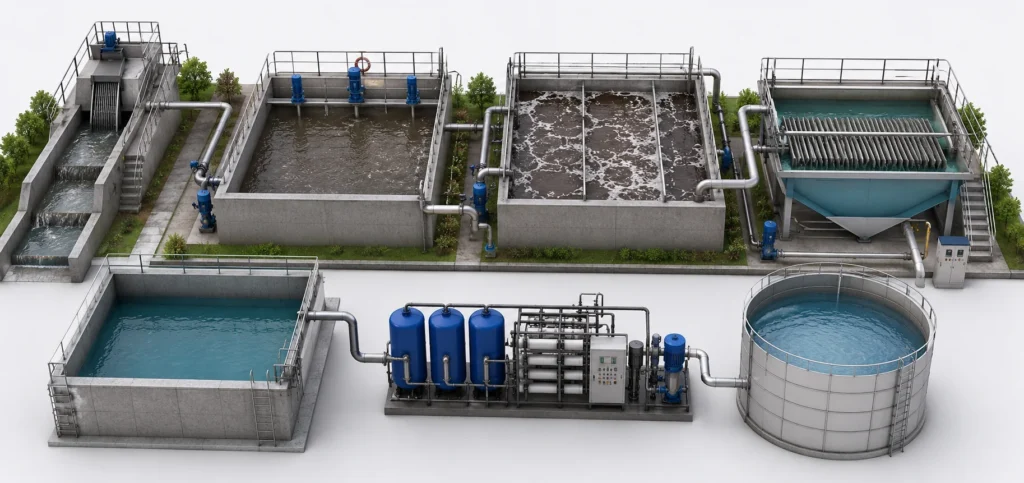
The treatment process inside an STP Plant takes place through multiple stages. Each stage is designed to remove specific contaminants and improve water quality.
1. Screening Process
Incoming sewage first passes through bar screens. Large solids, plastics, cloth pieces, and floating materials are removed at this stage.
2. Equalization Tank
The wastewater is collected in an equalization tank. Air is supplied through blowers to maintain uniformity and prevent sludge settlement.
3. Biological Treatment
The wastewater enters the biological treatment section. Beneficial bacteria break down organic pollutants and reduce BOD and COD levels.
4. Clarification Process
Solid particles settle inside the clarifier or tube settler tank. Clear water moves to the next treatment stage.
5. Filtration Process
Pressure Sand Filters and Activated Carbon Filters remove remaining suspended solids, color, and odor from the treated water.
6. Disinfection Process
Chlorination or UV treatment eliminates harmful microorganisms and pathogens.
7. Treated Water Storage
The treated water is stored and made available for reuse applications.
Major Components of an STP Plant
A high-performance STP Plant consists of several critical components.
- Bar Screen Chamber
- Collection Tank
- Equalization Tank
- Aeration Tank
- MBBR Media Reactor
- Tube Settler
- Pressure Sand Filter
- Activated Carbon Filter
- Disinfection Unit
- Sludge Handling System
- Treated Water Tank
The proper selection of these components ensures efficient operation and long-term reliability of the STP Plant.
Types of STP Plant Technologies
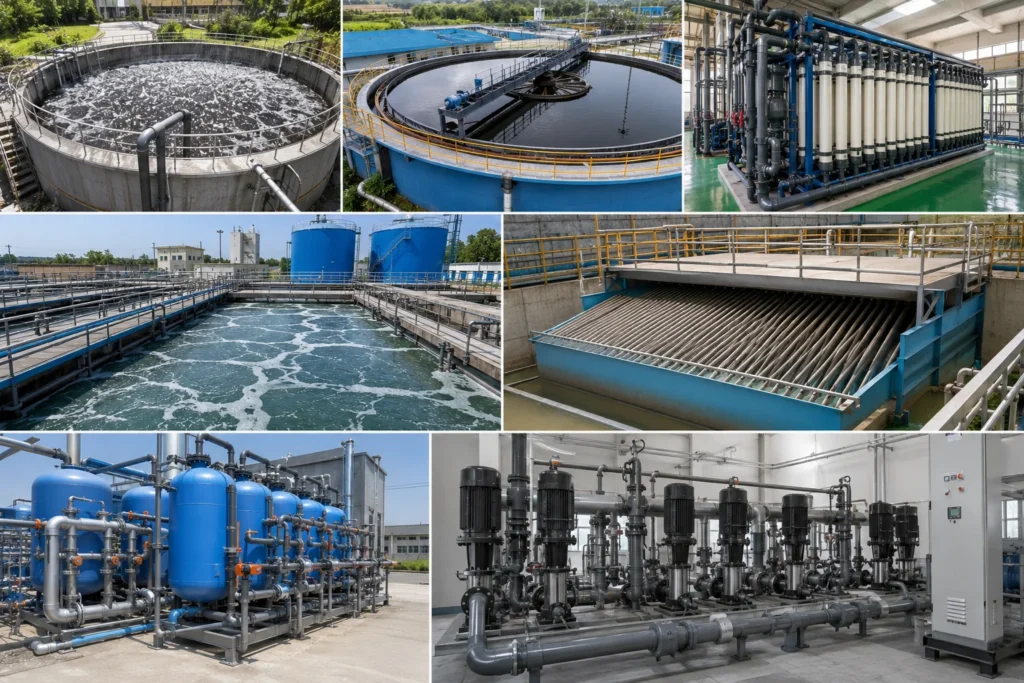
Different treatment technologies are available based on wastewater characteristics, available space, and treatment requirements.
MBBR STP Plant
MBBR (Moving Bed Biofilm Reactor) technology is widely used due to its compact design, high efficiency, and low maintenance requirements.
SBR STP Plant
SBR (Sequencing Batch Reactor) technology performs treatment in batches and delivers excellent treatment efficiency.
MBR STP Plant
MBR (Membrane Bioreactor) technology combines biological treatment with membrane filtration for superior water quality.
FAB STP Plant
FAB technology offers effective treatment with a smaller footprint and lower operational costs.
ASP STP Plant
Activated Sludge Process technology is a traditional and reliable sewage treatment solution used across various industries.
Applications of STP Plant
An STP Plant is suitable for a wide range of sectors.
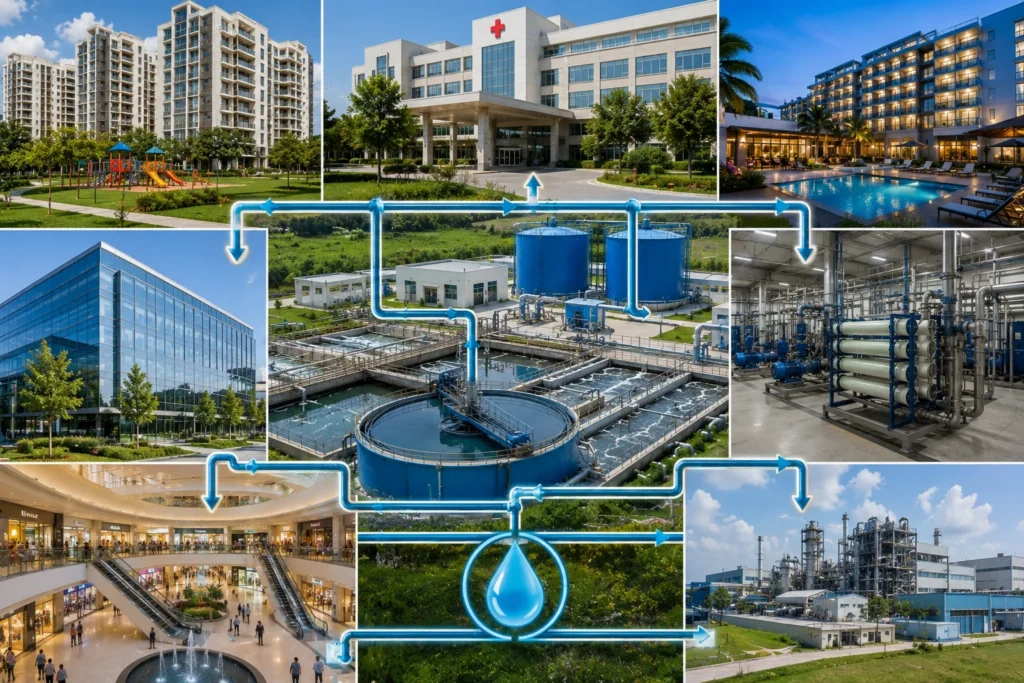
- Residential Societies
- Apartment Complexes
- Commercial Buildings
- Hotels and Resorts
- Hospitals
- Educational Institutions
- Shopping Malls
- IT Parks
- Industrial Facilities
- Manufacturing Units
Many organizations combine STP Plant systems with Industrial RO Plant solutions to maximize water recovery and reuse.
Benefits of Installing an STP Plant
An STP Plant offers both environmental and financial benefits. It helps organizations manage wastewater responsibly while reducing operating expenses.
Water Reuse and Conservation
A modern STP Plant converts wastewater into reusable water. The treated water can be used for flushing, gardening, landscaping, cooling towers, and cleaning purposes.
Regulatory Compliance
An STP Plant helps organizations comply with CPCB and State Pollution Control Board guidelines. Proper wastewater treatment reduces the risk of penalties and legal issues.
Lower Water Bills
Water recycling reduces dependence on municipal and groundwater sources. This directly lowers water procurement costs.
Environmental Protection
An STP Plant prevents untreated sewage from entering rivers, lakes, and groundwater sources. This helps protect ecosystems and public health.
Odor Control
Proper treatment reduces foul smells and improves the overall environment around the facility.
Sustainable Operations
Businesses and residential projects can achieve sustainability goals by implementing an efficient STP Plant.
STP Plant Capacity Range
Apiance Technology provides customized STP Plant solutions for different wastewater treatment requirements.
| STP Plant Capacity | Suitable Application |
|---|---|
| 5 KLD | Small Buildings & Villas |
| 10 KLD | Apartment Buildings |
| 25 KLD | Commercial Complexes |
| 50 KLD | Hotels & Institutions |
| 100 KLD | Residential Societies |
| 500 KLD+ | Large Industrial Projects |
Our engineering team evaluates wastewater characteristics, site conditions, and reuse requirements before recommending the ideal STP Plant capacity.
Talk to Our STP Plant Engineers
Need help selecting the right sewage treatment system? Speak directly with our experts for professional guidance.
STP Plant Installation Process
Every STP Plant project follows a systematic approach to ensure smooth execution and long-term performance.
Site Assessment
Our experts evaluate wastewater generation, available space, and treatment objectives.
System Design
The engineering team develops a customized STP Plant design based on project requirements.
Equipment Manufacturing
Quality components are selected and manufactured according to industry standards.
Installation
The STP Plant is installed by trained professionals with attention to safety and performance.
Testing & Commissioning
Complete performance testing is conducted before handing over the system.
Operator Training
Operational guidance is provided to ensure efficient plant management.
STP Plant Maintenance Services
Regular maintenance is essential for uninterrupted STP Plant performance. A well-maintained system delivers consistent water quality and extends equipment life.
- Annual Maintenance Contracts (AMC)
- Preventive Maintenance
- Pump Inspection
- Blower Maintenance
- Media Replacement
- Water Quality Testing
- Breakdown Support
- Spare Parts Supply
Explore our complete range of water treatment services designed to support residential, commercial, and industrial customers.
STP Plant vs ETP Plant
| Parameter | STP Plant | ETP Plant |
|---|---|---|
| Wastewater Source | Domestic Sewage | Industrial Effluent |
| Main Objective | Sewage Treatment | Chemical Waste Treatment |
| Treatment Process | Mainly Biological | Chemical & Biological |
| Applications | Residential & Commercial | Industrial Facilities |
Both systems are important for wastewater management. The selection depends on the type of wastewater generated.
Planning a New STP Plant Installation?
Get expert recommendations on STP Plant capacity, technology selection, layout planning, and compliance requirements.
Why Choose Apiance Technology for STP Plant Solutions?
Apiance Technology is a trusted provider of advanced water treatment and wastewater treatment systems. We focus on quality, reliability, and customer satisfaction.
- Experienced Engineering Team
- Customized STP Plant Design
- Advanced Treatment Technologies
- Energy-Efficient Solutions
- Quality Components and Equipment
- Professional Installation Support
- Maintenance and AMC Services
- Competitive Pricing
- Fast Technical Assistance
- Pan India Service Support
In addition to STP Plant solutions, we also provide Commercial RO Plant Services, Water Softener Services, industrial water treatment systems, and customized purification solutions.
About Apiance Technology
Apiance Technology is a leading provider of water purification and wastewater treatment solutions in India. We specialize in Domestic RO Systems, Commercial RO Plants, Industrial Water Treatment Systems, Water Softener Plants, and STP Plant solutions.
Our experienced technical team delivers reliable installation, maintenance, and support services. We focus on providing long-lasting treatment systems that help customers achieve water quality goals while reducing operational costs.
Address: Plot No 1122, Sector 37, Faridabad, Haryana 121003
Phone: +91 8929351211
Email: info@apiancetechnology.com
Visit our Products Page to explore our complete range of water treatment systems.
Frequently Asked Questions
What is the full form of STP Plant?
STP stands for Sewage Treatment Plant. It is used to treat domestic wastewater and make it suitable for reuse or discharge.
Can treated water from an STP Plant be reused?
Yes. Treated water can be reused for gardening, flushing, landscaping, cooling towers, and cleaning applications.
Which STP Plant technology is best?
MBBR, SBR, and MBR are among the most commonly used technologies. The ideal choice depends on wastewater quality, available space, and project requirements.
How much space is required for an STP Plant?
Space requirements depend on plant capacity and technology selection. Compact technologies such as MBBR and MBR require less installation area.
How often should an STP Plant be maintained?
Routine inspection and preventive maintenance should be performed regularly to ensure optimum performance and compliance.
How can I get a quote for an STP Plant?
You can contact our team for a customized consultation based on your wastewater treatment requirements. Visit our Contact Us page or call us directly for assistance.