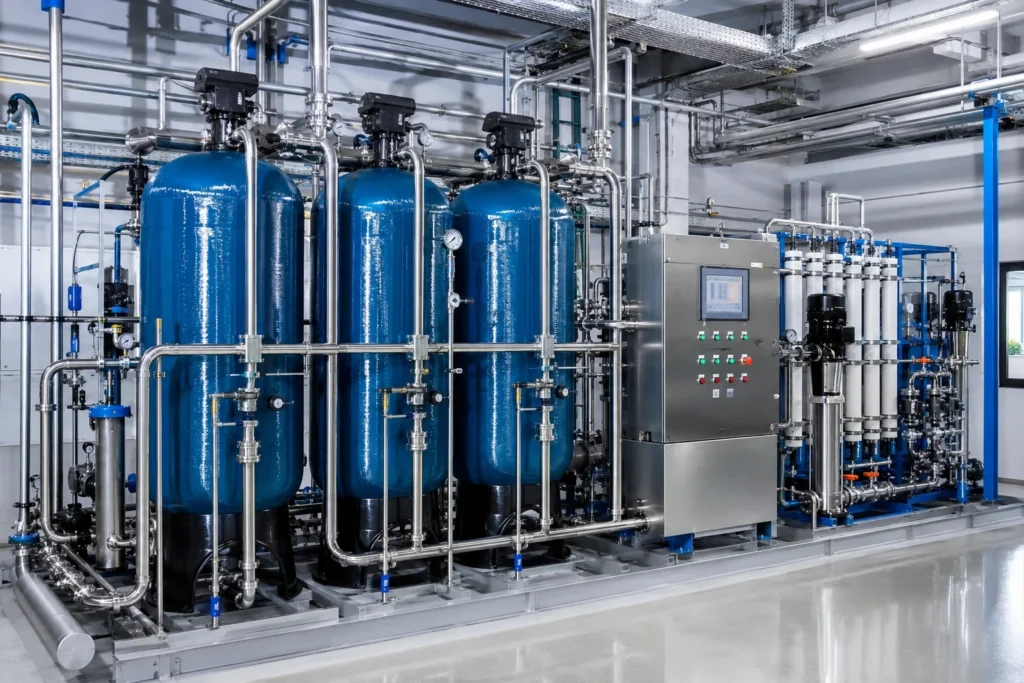
A DM Plant System is an advanced water treatment solution designed to remove dissolved salts, minerals, and ionic impurities from water. Industries that require high-purity water depend on a reliable DM Plant System to achieve consistent water quality and protect critical equipment from scaling, corrosion, and contamination.
At Apiance Technology, we design and supply high-performance DM Plant System solutions for industrial, commercial, and institutional applications. Our systems are engineered to deliver demineralized water with excellent purity levels while ensuring long-term operational efficiency.
We provide complete water treatment solutions, including Industrial RO Plant Manufacturer services, Commercial RO Plant Services, and Water Softener Service support for industries across India.
Looking for the Right DM Plant System?
Get expert guidance and a customized DM Plant System solution based on your water quality and production requirements.
What is a DM Plant System?
A DM Plant System, also known as a Demineralization Plant or Deionization Plant, is a water purification system that removes positively and negatively charged ions from water through the ion exchange process.
The primary objective of a DM Plant System is to produce mineral-free water suitable for industrial processes where even small amounts of dissolved salts can affect performance, product quality, or equipment life.
A typical DM Plant System removes:
- Calcium (Ca²⁺)
- Magnesium (Mg²⁺)
- Sodium (Na⁺)
- Chloride (Cl⁻)
- Sulfates (SO₄²⁻)
- Nitrates (NO₃⁻)
- Other dissolved minerals
The result is high-purity demineralized water suitable for demanding industrial applications.
How Does a DM Plant System Work?
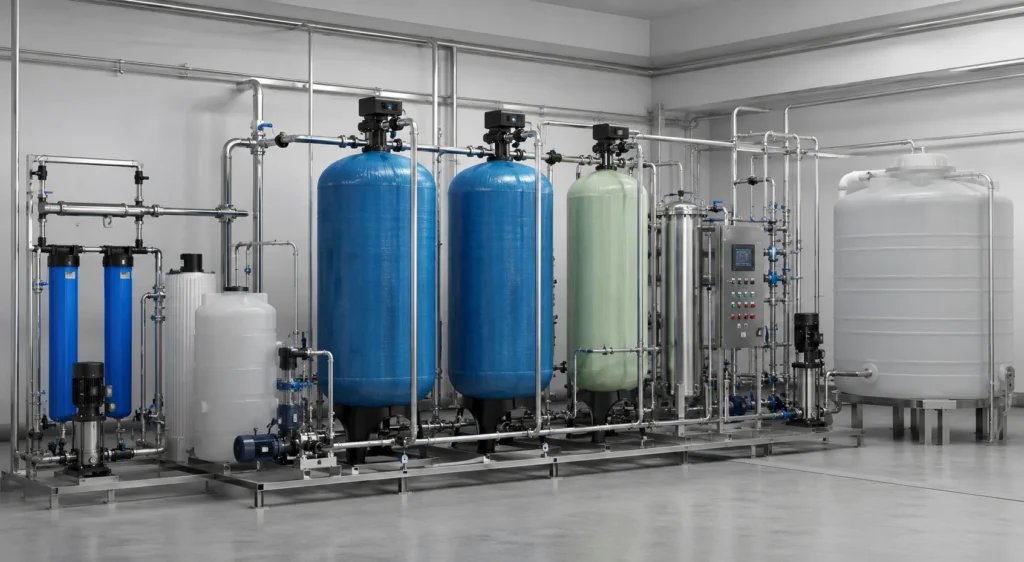
The working principle of a DM Plant System is based on ion exchange technology. The system uses specialized resins that replace dissolved ions with hydrogen (H⁺) and hydroxyl (OH⁻) ions. These ions combine to form pure water.
Step 1: Raw Water Treatment
Raw water first passes through pre-treatment units. These may include multimedia filters, activated carbon filters, and water softeners to improve feed water quality.
Step 2: Cation Exchange Unit
The cation resin removes positively charged ions such as calcium, magnesium, sodium, and iron. These ions are exchanged with hydrogen ions.
Step 3: Anion Exchange Unit
The water then enters the anion exchanger. This unit removes negatively charged ions such as chlorides, sulfates, nitrates, and bicarbonates. These ions are replaced with hydroxyl ions.
Step 4: Mixed Bed Polishing Unit
For ultra-pure water requirements, a mixed bed unit is installed after the two-bed DM Plant System. This stage provides final polishing and significantly reduces conductivity.
Step 5: Demineralized Water Storage
The purified water is collected in a storage tank and supplied to the application point.
Types of DM Plant Systems
Two Bed DM Plant System
This system consists of separate cation and anion exchange vessels. It is widely used in industrial water treatment applications where high-purity water is required.
Mixed Bed DM Plant System
A Mixed Bed DM Plant System contains both cation and anion resins in a single vessel. It provides superior water quality and very low conductivity levels.
Automatic DM Plant System
Automatic systems use PLC-based controls and automated regeneration cycles. They reduce manual intervention and improve operational reliability.
Industrial DM Plant System
Industrial DM Plant Systems are designed for large-capacity operations and continuous process requirements.
Main Components of a DM Plant System
- Pressure Vessels
- Cation Exchange Resin
- Anion Exchange Resin
- Mixed Bed Unit
- Control Valves
- Acid Dosing System
- Caustic Dosing System
- Conductivity Meter
- Storage Tank
- Piping Network
Each component plays a critical role in maintaining the efficiency and performance of the DM Plant System.
Applications of DM Plant System
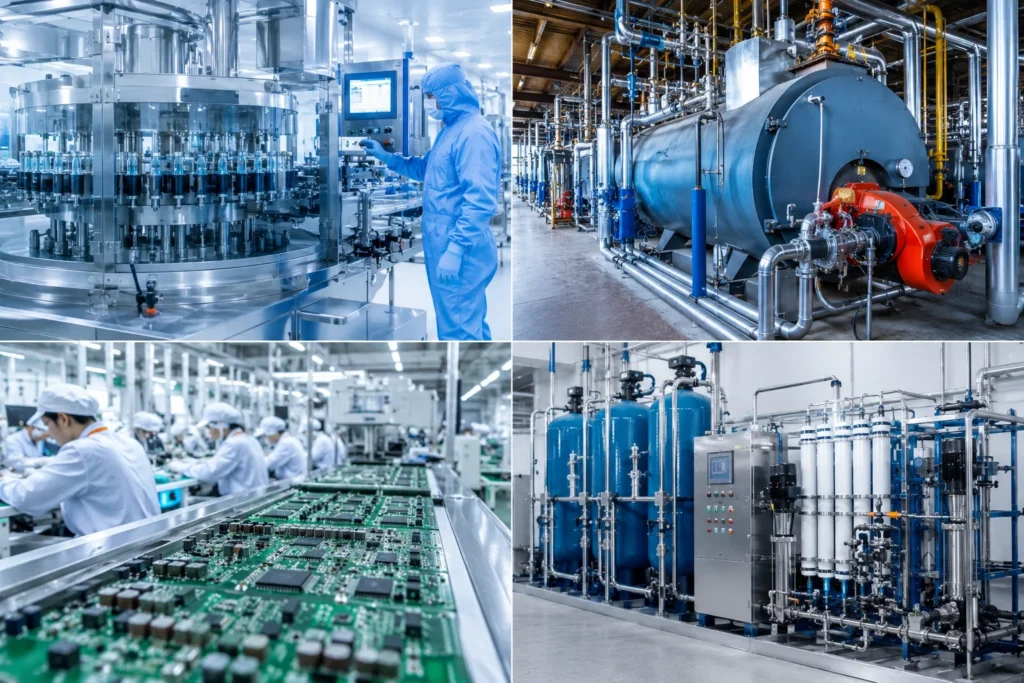
The demand for DM Plant System solutions continues to grow across various industries.
Power Plants
Boiler feed water requires extremely low mineral content. A DM Plant System helps prevent scaling and corrosion inside boilers.
Pharmaceutical Industry
Pharmaceutical manufacturing processes require high-purity water for formulations, cleaning, and production activities.
Electronics Manufacturing
Electronic components require mineral-free water during rinsing and cleaning operations.
Chemical Processing Plants
Chemical industries use DM water for process water, dilution, and equipment protection.
Hospitals and Laboratories
Laboratories and healthcare facilities depend on purified water for testing, research, and sterilization procedures.
Food & Beverage Industry
Many food processing operations use treated water to maintain product quality and production consistency.
DM Plant System Capacity Range
Apiance Technology provides customized DM Plant System solutions in different capacities.
- 100 LPH DM Plant System
- 250 LPH DM Plant System
- 500 LPH DM Plant System
- 1000 LPH DM Plant System
- 2000 LPH DM Plant System
- 5000 LPH DM Plant System
- 10000 LPH DM Plant System
- Customized Industrial DM Plant System
The final capacity depends on feed water quality, daily water demand, and application requirements.
Speak with a DM Plant Expert
Discuss your demineralized water requirements and get recommendations for the right DM Plant System.
Technical Specifications of DM Plant System
| Parameter | Specification |
|---|---|
| Plant Capacity | 100 LPH to 50,000 LPH |
| Technology | Ion Exchange |
| Output Water Quality | Less than 10 PPM TDS |
| Conductivity | Less than 20 µS/cm |
| Operation | Manual, Semi-Automatic, Automatic |
| Vessel Material | FRP, MSRL, Stainless Steel |
| Resin Type | Strong Acid Cation & Strong Base Anion |
| Application | Industrial & Commercial Water Treatment |
DM Plant System vs RO Plant
Many industries compare a DM Plant System with an RO Plant before selecting a water treatment solution. Both technologies remove impurities, but their working principles are different.
| Feature | DM Plant System | RO Plant |
|---|---|---|
| Technology | Ion Exchange | Membrane Filtration |
| Salt Removal | Nearly 100% | 95% – 99% |
| Water Purity | Ultra High | High |
| Conductivity | Very Low | Moderate |
| Industrial Boilers | Highly Recommended | Limited Use |
Many industries use a DM Plant System after an RO system to achieve higher purity levels. You can also explore our Industrial RO Plant Manufacturer solutions for complete water treatment requirements.
DM Plant System vs Water Softener
| Feature | Water Softener | DM Plant System |
|---|---|---|
| Calcium Removal | Yes | Yes |
| Magnesium Removal | Yes | Yes |
| All Dissolved Salts Removal | No | Yes |
| Conductivity Reduction | No | Yes |
| High Purity Water | No | Yes |
For hardness control applications, you may also require our professional Water Softener Service.
DM Plant System Installation Process
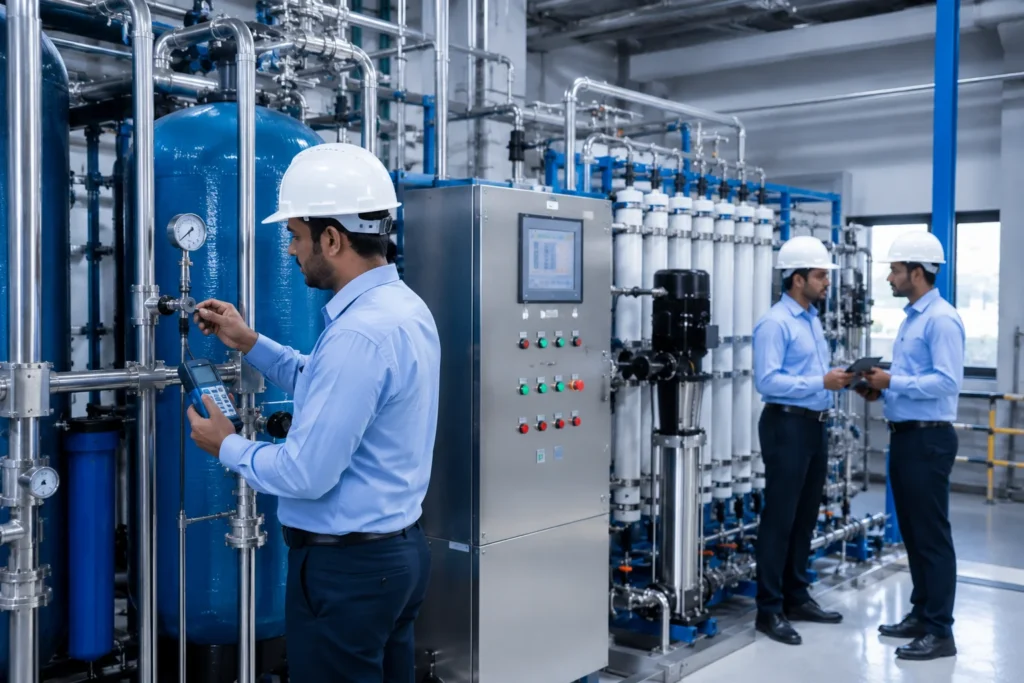
At Apiance Technology, every DM Plant System is designed according to the client’s water quality and production requirements.
- Raw Water Analysis
- Site Inspection
- System Design & Engineering
- Plant Manufacturing
- Equipment Installation
- Pipeline Integration
- Commissioning & Testing
- Operator Training
- After-Sales Support
Our engineering team ensures that every DM Plant System performs efficiently and meets industrial water quality requirements.
DM Plant System Maintenance Guide
Regular maintenance is important for the long-term performance of a DM Plant System.
- Monitor conductivity regularly.
- Check resin performance periodically.
- Perform timely regeneration cycles.
- Inspect valves and pipelines.
- Monitor chemical consumption.
- Clean strainers and filters.
- Replace damaged components when required.
- Schedule preventive maintenance visits.
Proper maintenance improves resin life, reduces downtime, and ensures consistent water quality.
Common DM Plant System Problems & Solutions
| Problem | Possible Cause |
|---|---|
| High Conductivity | Resin Exhaustion |
| Low Water Flow | Blocked Media or Piping |
| Poor Water Quality | Improper Regeneration |
| Excess Chemical Consumption | Incorrect Operating Parameters |
| Pressure Drop | Fouled Resin Bed |
| Water Leakage | Valve or Pipeline Damage |
Why Choose Apiance Technology for DM Plant System?
- Customized DM Plant System solutions.
- Industry-specific system design.
- High-quality ion exchange resins.
- Reliable automation options.
- Professional installation support.
- Experienced water treatment engineers.
- Fast service response.
- Long-term maintenance support.
We provide complete water treatment solutions through our Water Treatment Services portfolio. Our team helps industries select the right DM Plant System based on water quality, application, and production requirements.
Need a Custom DM Plant System Design?
Our engineers will recommend the ideal DM Plant System based on raw water quality, capacity, and application needs.
Frequently Asked Questions
What is a DM Plant System?
A DM Plant System is a water treatment system that removes dissolved minerals and salts using ion exchange technology.
What is the full form of DM Plant?
DM stands for Demineralization Plant.
How does a DM Plant System work?
It removes dissolved ions through cation and anion exchange resins to produce demineralized water.
What is DM water used for?
DM water is used in power plants, pharmaceutical industries, laboratories, electronics manufacturing, and chemical processing.
What is a Mixed Bed DM Plant System?
It is a polishing unit containing mixed cation and anion resins for ultra-high purity water.
What conductivity can a DM Plant System achieve?
Depending on design, conductivity can be reduced to less than 20 µS/cm or lower.
What is the difference between DM water and RO water?
DM water has significantly lower conductivity and mineral content compared to RO water.
Why is DM water used in boilers?
It helps prevent scale formation, corrosion, and efficiency loss.
How often should resin be regenerated?
Regeneration frequency depends on water quality, operating hours, and resin capacity.
What industries use a DM Plant System?
Power plants, pharmaceuticals, food processing, electronics, hospitals, laboratories, and chemical industries.
Can a DM Plant System be customized?
Yes. Plant capacity, automation level, and vessel material can be customized.
What is the lifespan of ion exchange resin?
With proper maintenance, resin can last several years.
Do you provide installation services?
Yes. Apiance Technology provides complete installation and commissioning support.
Do you provide maintenance support?
Yes. We offer inspection, servicing, troubleshooting, and preventive maintenance support.
How can I choose the right DM Plant System?
The ideal system depends on raw water quality, required output quality, and daily water consumption.
Get a Customized DM Plant System Solution
If you are looking for a reliable DM Plant System manufacturer and supplier, Apiance Technology can help. Our team designs efficient and durable water treatment solutions for industries across India.
We also provide Commercial RO Plant Services, Industrial RO Plants, Water Softeners, AMC Support, and complete water treatment solutions.
Apiance Technology
Plot No 1122, Sector 37, Faridabad, Haryana 121003
Phone: +91 8929351211
Email: info@apiancetechnology.com
Contact Us Today to discuss your DM Plant System requirements and receive a customized solution from our water treatment experts.